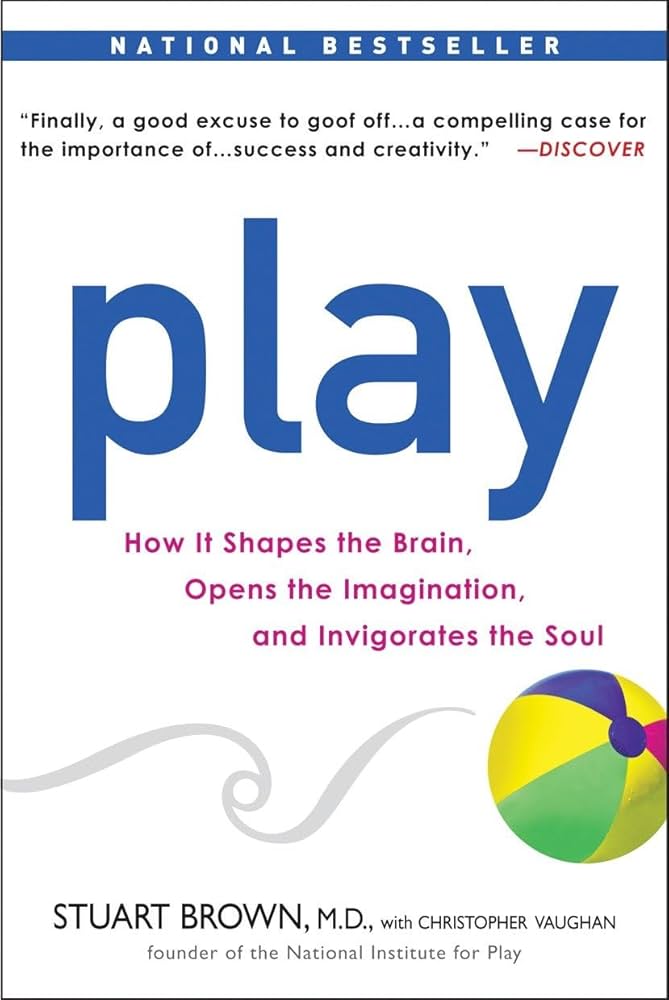
Play is often treated as a break from learning.
Something extra. Something optional. Something we do after the real work is done.
Stuart Brown’s Play turns that idea completely on its head.
Play is not a luxury. It is a biological need.
Brown’s research shows that play is not just beneficial. It is essential.
Across cultures, ages, and even species, play appears wherever learning, adaptation, and wellbeing matter.
When play disappears:
- Curiosity fades
- Flexibility shrinks
- Creativity drops
- Motivation suffers
This is not philosophical. It is neurological.
What happens when play is squeezed out
Modern childhood has quietly lost a lot of play.
More structure. More schedules. More performance pressure.
And increasingly, more passive digital entertainment.
Children spend time watching play rather than doing it.
Brown argues this comes at a real cost to emotional regulation, problem solving, and joy.
Play and technology are not opposites
Technology is often blamed for the loss of play. But the problem is not technology itself. It is how it is used.
Passive use replaces play. Creative use is play.
Building, tinkering, experimenting, remixing, these are modern forms of play.
Why creative tech feels different
Play has a few defining features:
- It is voluntary
- It is absorbing
- It involves experimentation
- It has room for failure
Well designed creative projects with technology check every box.
Children lose track of time. They test ideas. They make mistakes. They try again.
That is play doing its work.
The danger of productive childhood
Brown warns against over valuing outcomes.
When everything must be efficient, look impressive, or serve a future goal, play disappears.
Ironically, this undermines the very skills we want children to develop: creativity, persistence, originality.
Projects work because they give play a legitimate place again.
Old school play, new tools
What looks like screen time from the outside can actually be:
- Digital Lego
- Storytelling
- Musical experimentation
- Invention
The medium has changed. The instincts have not.
Children still want to explore, build, and imagine.
Why play builds resilience
Play introduces challenge without threat.
Children voluntarily push themselves. They recover from failure. They stay engaged.
This is how resilience grows, not through lectures, but through experience.
Projects that feel playful invite children to stretch themselves safely.
Play does not mean chaos
Play is not the absence of structure. It is flexible structure.
Clear tools. Clear boundaries. Room to explore inside them.
That balance is where creativity thrives.
What this means for parents
Instead of asking:
- Is this educational?
- Is this productive?
Try asking:
- Is my child experimenting?
- Are they absorbed?
- Are they building something?
If the answer is yes, play is happening.
Play is where learning sticks
Play reminds us that joy and learning are deeply connected.
Children do not grow best when everything is serious. They grow best when they are engaged.
Used well, technology does not replace play. It becomes one of its most powerful modern tools.
And when children are allowed to play, to truly play, they do not just learn more. They become more themselves.
If you are new to this series, the intro post explains the bigger picture behind these reflections.
The Scratch project post is a playful example of learning through making.
Better Tech Kids
Better Tech Kids is full of playful projects that help children create without pressure.