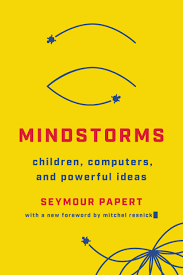
Some books age badly. Mindstorms is not one of them.
Written decades before tablets, apps, or social media, Seymour Papert’s ideas feel almost uncannily relevant today. While the technology he references is old, the thinking behind it is timeless.
When I first encountered Mindstorms, it reframed how I thought about both computers and children.
Children learn best when they are building something
At the heart of Mindstorms is a simple but powerful idea. Children learn deeply when they are actively constructing something that matters to them.
Not filling in worksheets. Not following rigid instructions. Not passively receiving information. But building.
Papert believed that computers were powerful not because they delivered information, but because they allowed children to explore ideas, test hypotheses, and see their thinking made visible.
Computers as objects to think with
Papert introduced the idea of computers as objects to think with.
In other words, tools that help children:
- Externalise their thinking
- Experiment safely
- Revise ideas through feedback
- Learn through iteration rather than correctness
This is very different from how many people still imagine educational technology.
The computer is not a tutor. It is not a babysitter. It is not a reward. It is a workshop.
Why discovery matters more than instruction
One of Papert’s most challenging ideas is that children often learn despite instruction, not because of it.
He argued that when children are given the right tools and the freedom to explore, they:
- Discover patterns on their own
- Develop personal strategies
- Build understanding that sticks
This does not mean abandoning guidance. It means shifting from control to coaching.
Instead of asking, “Did you do it right?” we ask, “What did you notice?” “What happened when you changed that?” “What do you want to try next?”
Motivation comes from ownership
A key insight in Mindstorms is that motivation is not something we add after learning. It emerges when learners feel ownership.
When a child is working on a project they care about:
- Attention lasts longer
- Frustration is tolerated
- Mistakes become useful
This is especially important in a world where so much technology is designed to capture attention without effort. Papert showed that effort is not the enemy of engagement. Meaninglessness is.
From programming to thinking
Although Mindstorms is often associated with early programming, its real contribution is philosophical.
Programming was not important because children would all become programmers. It mattered because it taught:
- Logical thinking
- Debugging
- Persistence
- Cause and effect
Those skills transfer far beyond a screen.
Why Mindstorms still matters now
In a digital world dominated by polished apps and instant entertainment, Mindstorms reminds us that children do not need more seamless experiences.
They need tools that allow tinkering, spaces where effort shows, and permission to explore without a script.
When technology hides complexity, children consume. When it reveals it, they create.
A quiet but radical idea
Papert was not arguing for more technology in children’s lives. He was arguing for better uses of it. Uses that respect children as thinkers. Uses that treat curiosity as a strength. Uses that assume children are capable of more than we expect.
That idea feels just as radical now as it did then.
If you are new to this series, the intro post explains the bigger picture behind these reflections.
The Scratch project post is a practical place to start if you want to put these ideas into action.
Better Tech Kids
Better Tech Kids takes the constructionist spirit of Mindstorms and turns it into simple, family-friendly projects.