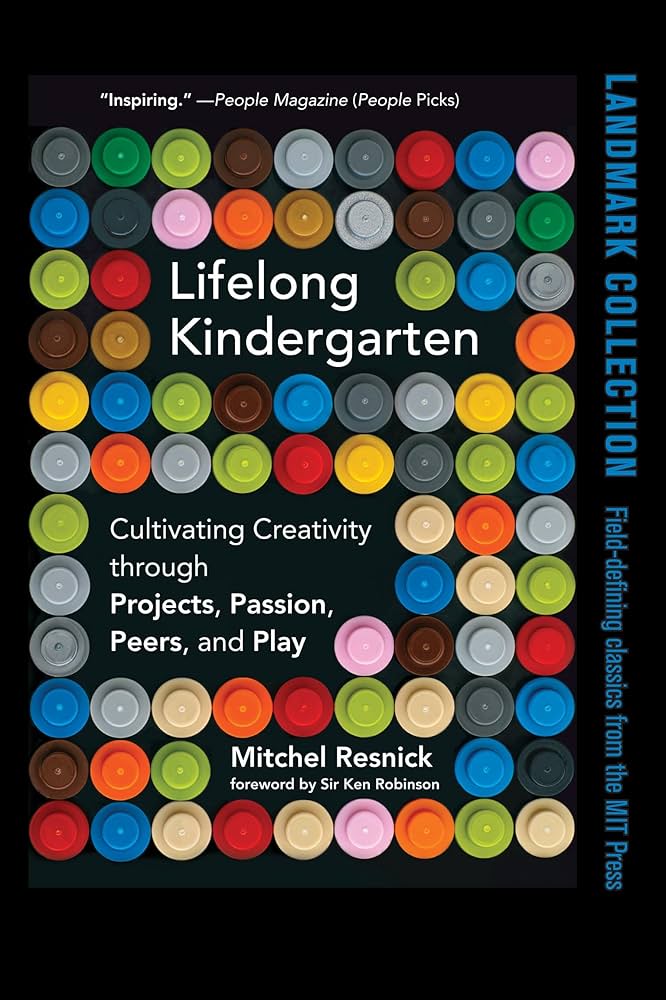
If Mindstorms laid the foundations, Lifelong Kindergarten shows us what those ideas can look like in the modern world.
Mitchel Resnick, who leads the Lifelong Kindergarten group at MIT and helped develop Scratch, takes Seymour Papert’s thinking and asks a simple question. What if the way children learn best in kindergarten did not stop at age five?
The problem is not that kids stop learning. It is that learning changes shape.
In early childhood, learning looks like this:
- Play
- Experimentation
- Making things
- Telling stories
- Trying again
Then, somewhere along the way, learning becomes more about:
- Following instructions
- Getting the right answer
- Avoiding mistakes
- Finishing quickly
Lifelong Kindergarten challenges that shift.
Resnick argues that the most powerful learning environments, at any age, look more like a kindergarten than a lecture hall.
The Creative Learning Spiral
At the heart of the book is the Creative Learning Spiral.
- Imagine
- Create
- Play
- Share
- Reflect
- Imagine again
This is not a straight line. It is a loop.
Children come up with an idea, build something, test it, share it, learn from feedback, and then refine or reimagine it.
Importantly, this process:
- Values iteration over perfection
- Treats mistakes as information
- Builds confidence through completion
It is also how most real world creative work actually happens.
Why Scratch matters and why it is not really about coding
Scratch features heavily in Lifelong Kindergarten, but not because Resnick thinks coding is the ultimate skill.
Scratch matters because it:
- Lowers the barrier to making
- Makes thinking visible
- Encourages remixing and sharing
- Allows kids to start small and grow
Children do not just follow tutorials. They tinker. They change things. They break things. They fix them.
The learning happens inside that messiness.
Passion projects beat prescribed tasks
One of Resnick’s strongest claims is that learning sticks when it is driven by personal interest. When kids work on projects they care about, they persist longer, take risks, and develop their own standards of quality.
This does not mean every moment has to be joyful. It means the effort feels worthwhile.
A child debugging a game they want to finish will happily work far longer than one completing a task they were assigned.
Peers matter more than we think
Learning is not just individual. It is social.
Children learn by:
- Seeing what others have made
- Borrowing ideas
- Giving feedback
- Explaining their thinking
This kind of sharing builds both competence and confidence. It also mirrors how adults learn in creative fields.
The danger of too polished technology
Resnick warns that many modern tools are too seamless.
When technology hides complexity:
- Children consume
- Choices are limited
- Learning becomes shallow
When technology invites tinkering:
- Children experiment
- Systems become understandable
- Creativity emerges
This distinction matters more now than ever.
Why this book matters beyond classrooms
Although Lifelong Kindergarten is written with education in mind, its ideas apply just as strongly at home. Any environment where children have access to creative tools, time to explore, encouragement to share, and permission to revise can become a powerful learning space.
You do not need to recreate a classroom. You need to protect the conditions where curiosity can survive.
A reminder worth holding onto
Perhaps the most important idea in Lifelong Kindergarten is this. Learning does not need to become more rigid as children grow. It needs to become deeper.
Play, projects, and making are not childish distractions. They are the engine of creative thinking.
That is a message worth carrying far beyond kindergarten.
If you are new to this series, the intro post explains the bigger picture behind these reflections.
The podcast project post is a practical place to start with creative learning at home.
Better Tech Kids
Better Tech Kids takes the playful project approach and makes it doable at home with limited time and simple tools.