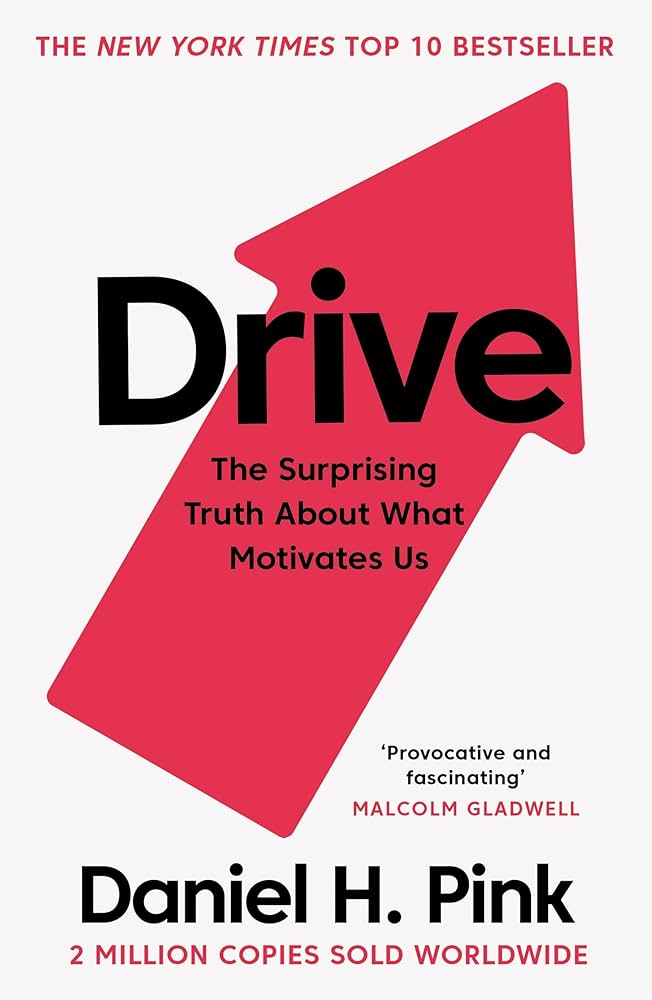
When adults talk about motivating children, we often reach for the same tools.
- Rewards
- Stickers
- Prizes
- Points
- Praise tied to outcomes
Drive challenges this approach at its core.
Daniel Pink shows that many of the strategies we assume increase motivation actually do the opposite, especially for creative, complex work.
The problem with if then motivation
If you do this, then you get that.
This model works reasonably well for simple, mechanical tasks. But for work that requires thinking, creativity, or problem solving, it often backfires.
Pink’s research shows that external rewards can:
- Narrow focus
- Reduce risk taking
- Make people less creative
- Weaken long term motivation
In other words, rewards can help people finish tasks, but they often stop them from loving the work.
The three drivers of real motivation
Drive argues that humans are motivated by three deeper needs.
Autonomy. The desire to have control over what we do and how we do it.
Mastery. The urge to get better at something that matters.
Purpose. The feeling that what we are doing has meaning beyond ticking a box.
These drivers show up clearly when children are deeply engaged in projects.
Why projects work better than incentives
When a child chooses to:
- Build a game
- Record a podcast
- Design something for a real audience
They are not asking, “What do I get if I finish?”
They are thinking:
- “Can I make this better?”
- “How does this work?”
- “What should I try next?”
That is mastery at work.
When they decide what to build and how to approach it, autonomy is present.
And when the project connects to something real, purpose appears naturally. No sticker chart required.
The quiet danger of over rewarding
One of the most uncomfortable ideas in Drive is that rewards can train children to expect payment for effort.
Over time, this can lead to:
- Reluctance to start unless there is a prize
- Reduced persistence when things get hard
- Less joy in the work itself
This is especially risky in creative spaces, where experimentation and intrinsic interest matter most.
Technology amplifies this effect
Digital environments are full of external motivators:
- Likes
- Points
- Streaks
- Badges
- Notifications
These systems train the brain to chase feedback rather than satisfaction.
Creative tech projects flip that equation. Progress becomes the reward.
Motivation grows from doing, not convincing
Motivation is not something we can lecture into existence. It emerges when conditions are right.
Children do not need to be told that creating is more meaningful than consuming. They discover it when:
- Effort leads to visible progress
- Skills improve over time
- They feel ownership of the work
That experience is far more powerful than any external incentive.
What this means for parents
If a child seems unmotivated, it is worth asking:
- Do they have real autonomy?
- Is there space to improve at something they care about?
- Does the work have any purpose beyond finishing?
Often the issue is not laziness. It is lack of meaningful ownership.
Why this matters for creative technology
Using technology as a creative tool aligns perfectly with the ideas in Drive.
Projects naturally support:
- Autonomy through choice
- Mastery through iteration
- Purpose through real outcomes
That is why children can spend hours refining something they chose to make, while resisting tasks that feel imposed.
Motivation follows meaning
Drive reminds us that children do not need to be bribed into doing meaningful work. They need the chance to experience it.
When technology becomes a place for creating rather than consuming, motivation stops being a problem to solve and becomes a by product of good design.
If you are new to this series, the intro post explains the bigger picture behind these reflections.
The projects post shares why making things gives children a grounded relationship with screens.
Better Tech Kids
Better Tech Kids focuses on projects that build motivation through autonomy and progress, not pressure.