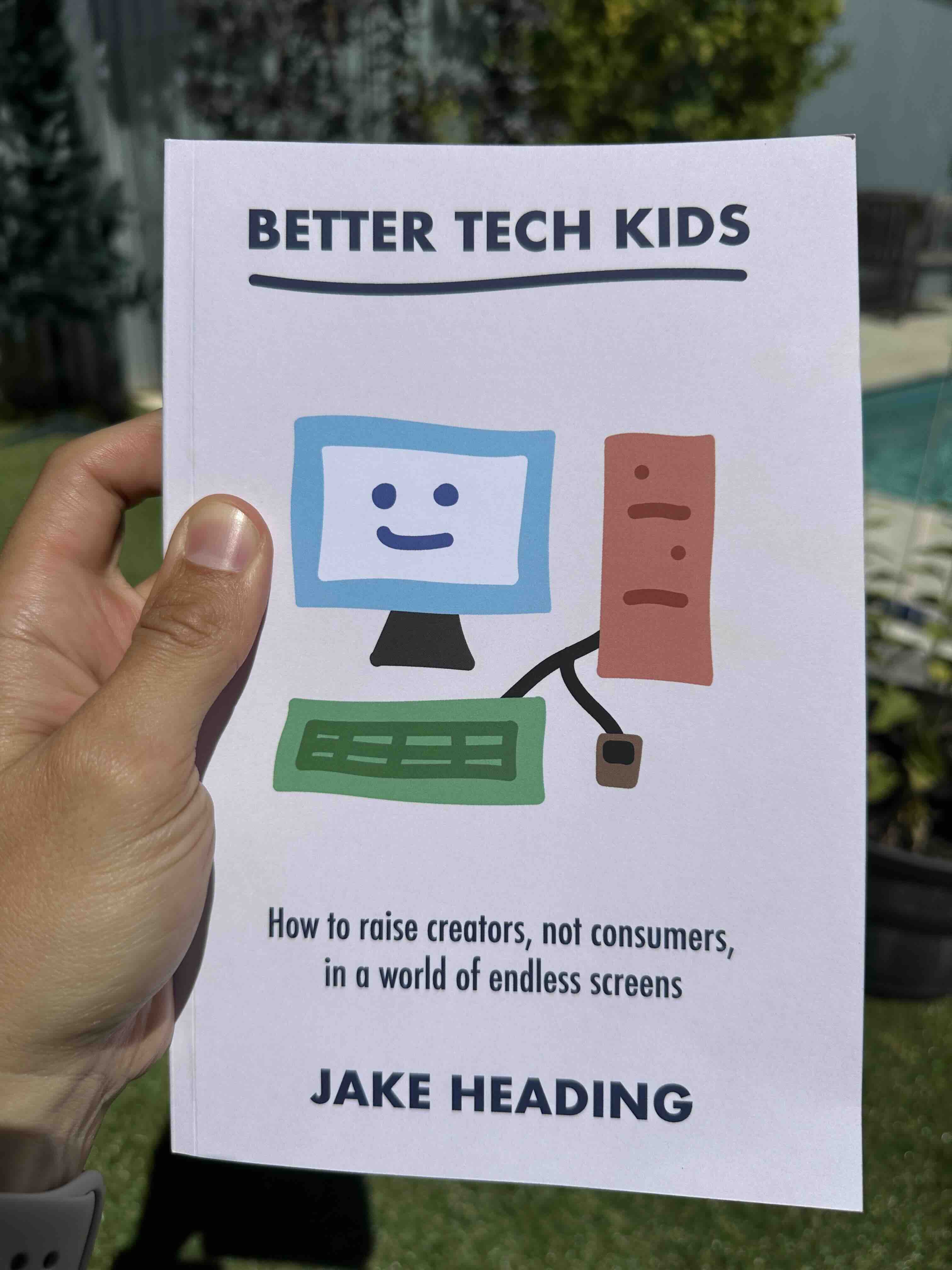
How this page works
This page organises the core truth claims from Better Tech Kids and the research areas that support them. It is a living resource. I will add specific papers and summaries over time, so you can dig deeper into the evidence.
- Each section links a book claim to research domains.
- Specific papers and summaries will be added under each claim.
- Use this page if you want the academic backbone for the ideas in the book.
1. Attention can be developed
Why this matters: It challenges the idea that screens only destroy attention.
Core claim: Sustained attention can grow through effortful, goal-directed tasks, including some technology-based activities.
Evidence summary
Attention is not fixed. It can be strengthened with the right kind of practice, especially when kids are doing effortful, goal-directed activities that make them concentrate and adjust what they are doing. For example, a school-based study with Year 5 and 6 students found that a weekly 12-week focus training program led to measurable improvements on an attention scale used with elementary students (Lai, 2020). Another study with 8–9-year-olds found that an 8-week kata training program improved sustained attention and related cognitive performance (Gokdere, 2025). And on the technology side, a large research literature shows that training with action video games can improve aspects of attentional control beyond the game itself (Green & Bavelier, 2012), which supports the broader point that attention can grow when kids repeatedly practise sustained focus in activities that demand it.
2. Not all screen time is cognitively equal
Why this matters: It is the foundation of the book.
Core claim: Passive consumption and active creation lead to different cognitive and emotional outcomes.
Evidence summary
Not all screen time is cognitively equal. What kids do on a screen matters far more than the fact they used a screen. In an open-access study of 5-6-year-olds, researchers found that more passive TV-style viewing was linked with weaker phonological memory (a key part of early language processing), while interactive "smart screen" use (tablets/phones) was not associated with the same negative effect (Veraksa et al., 2021). A large open-access review on infants and toddlers makes the same point at a broader level: the impact of screens depends on context such as content, caregiver involvement, and especially interactivity, meaning screen use can be positive, neutral, or negative depending on how it is used (Guellai et al., 2022). This lines up with multimedia learning research showing that meaningful learning requires active cognitive processing (selecting, organizing, integrating), which is much more likely in interactive, goal-directed use than in passive viewing (Mayer, 2002).
3. Technology can strengthen problem solving
Why this matters: It reframes technology as a tool for thinking.
Core claim: When used to design, build, debug, or create, technology can strengthen problem-solving and persistence.
Evidence summary
Technology can improve kids' problem-solving when it is used as a tool for creating, not just consuming. A large meta-analysis of coding and computational thinking interventions for ages 4-16 found that teaching coding significantly improved problem-solving, and it was the biggest effect they saw across the executive-function outcomes they measured (Montuori et al., 2024). At a smaller classroom level, a study of 7-9-year-olds doing a 6-week coding curriculum with the KIBO robot found that children's unplugged (non-coding) problem-solving skills improved over the course of the program and were linked with their coding proficiency (Relkin & Bers, 2020). And a year-long kindergarten robotics program (ages 4-6) showed children in the robotics group reported higher confidence in solving problems "when things don't work as expected," and also performed better on an object repair task than the control group (Zviel-Girshin & Rosenberg, 2025).
4. Creation builds persistence
Why this matters: It supports the claim that projects create natural stopping points and effort.
Core claim: Iterative projects develop grit, tolerance for frustration, and follow-through.
Evidence summary
Creation-based digital activities tend to build persistence because they pull kids into a loop of goal, effort, snag, fix, and finish. In makerspace style learning, Adam Maltese and colleagues surveyed maker educators and found that failure is common during making, and educators described concrete ways to help those failure moments turn into stronger learning and persistence (Maltese et al., 2018). This lines up with Self-Determination Theory, which argues that when kids feel autonomy and competence they are more likely to self-regulate and stick with challenging goals (Ryan & Deci, 2000), and a large meta-analysis in student settings links need-supportive environments with better engagement and persistence (Howard et al., 2024). Passive consumption, on the other hand, is often designed to reduce effort and remove the moment to stop. In a three-week home study with preschoolers, a "post-play" autoplay design that minimised natural stopping points significantly reduced children's autonomy and likelihood of self-regulation and extended viewing time (Hiniker et al., 2018).
5. Motivation grows with ownership
Why this matters: It explains why kids often go deep when creating.
Core claim: Motivation rises when children choose, shape, and own what they make.
Evidence summary
Kids are usually more motivated when they feel agency and ownership over what they are making, because it taps into intrinsic motivation. Self-Determination Theory explains this really well: motivation tends to be stronger when learning environments support autonomy (having a say), competence (feeling capable and improving), and relatedness (feeling connected) (Ryan & Deci, 2000). This is not just theory either. A meta-analysis of 41 studies found that giving people meaningful choice increases intrinsic motivation, effort, task performance, and perceived competence (Patall, Cooper, & Robinson, 2008), and a very large education meta-analysis links need-supportive teaching (including autonomy support) with stronger student motivation and engagement (Howard, Slemp, & Wang, 2024). In a concrete example with children, a study of 110 Grade 3 students found that manipulating choice in a reading task increased children's enjoyment and improved performance, which is a neat illustration of how agency can lift engagement quickly (Fridkin et al., 2025).
6. Availability shapes behaviour
Why this matters: It underpins the digital pantry idea.
Core claim: Behaviour is strongly influenced by what tools and cues are most visible and accessible.
Evidence summary
Availability shapes behavior because people tend to choose whatever is most visible and easy in their environment rather than relying on willpower alone. A comprehensive meta-analysis of choice architecture experiments (covering over 200 studies and ~2.1 million participants) found that nudges altering the structure of choices (such as defaults, reducing friction, or changing what options are available) reliably promote behavior change, and these structural interventions consistently outperform those that merely provide information (Cadario & Chandon, 2020). In one classic demonstration, simply placing snack foods farther away from people significantly reduced their consumption, an effect that held true regardless of individuals' levels of self-control or "cognitive resource" (Wansink, Painter, & Lee, 2006). Habit science explains this pattern: once a habit is formed, stable context cues can trigger the behavior automatically without the need for conscious deliberation (Wood & Neal, 2007). Even in digital settings, interface design cues matter; a three-week home study with preschoolers showed that an auto-play "post-play" feature (which automatically plays the next video) undermined children's autonomy and self-regulation and led to longer viewing time (Hiniker et al., 2018). These findings illustrate how whatever is most available and frictionless in our surroundings can strongly steer our actions, underpinning the "digital pantry" idea that availability drives behavior.
7. Projects have natural stopping points
Why this matters: It addresses the fear that creative tech means endless screen time.
Core claim: Projects end when a goal is reached, unlike infinite scroll systems.
Evidence summary
Projects tend to have natural stopping points because they are goal-based (finish the edit, fix the bug, export the project), while many consumption platforms are designed to remove stopping cues and keep you going. In a three-week field experiment in 24 homes with preschoolers, an autoplay "post-play" design reduced children's autonomy and self-regulation and extended viewing time, showing how removing the pause makes it harder to stop (Hiniker et al., 2018). A controlled experiment with 76 Netflix users found that disabling autoplay reduced average daily watching and shortened sessions, suggesting that restoring a moment to decide helps people disengage (Schaffner et al., 2025). And a field study on infinite scrolling reports that endless feeds can make users feel "caught in a loop," linking infinite scroll with regretful, elongated sessions (Rixen et al., 2023).
8. Learning deepens through making
Why this matters: It supports the project-first philosophy.
Core claim: Learning embedded in meaningful projects leads to stronger retention and transfer.
Evidence summary
Kids often learn more deeply when knowledge is embedded in making something, because projects make them use ideas in context, solve real problems, and keep pulling knowledge back out as they build and revise. A classic paper on situated cognition argues that learning develops through authentic activity and the use of real tools, not just abstract instruction (Brown, Collins, & Duguid, 1989). Backing that up at scale, a meta-analysis of 66 experimental or quasi-experimental studies found project-based learning significantly improved student learning outcomes (including thinking skills and academic achievement) compared with traditional teaching (Zhang & Ma, 2023). One reason projects can improve retention is that they naturally force retrieval and application, and retrieval-practice research shows that testing yourself leads to better long-term retention than re-studying, even when re-studying feels easier in the moment (Roediger & Karpicke, 2006).
9. Creativity and technical skill reinforce each other
Why this matters: It pushes back on the idea that tech crowds out creativity.
Core claim: Tools that enable making can amplify imagination and originality.
Evidence summary
Contrary to the idea that technology dampens imagination, evidence shows that using making tools often boosts creativity. For example, preschoolers who engaged in hands-on robotics and coding projects made significantly larger gains in both problem-solving and creative thinking than peers in traditional activities (Cetin & Demircan, 2022).
Learning by making approaches (for example, design thinking or maker projects) tend to increase engagement, motivation, and imagination. Design-oriented activities can facilitate deeper learning as well as creativity and original thinking (Hua et al., 2023).
Reviews of children's software and devices highlight that well-designed tools encourage playfulness, collaboration, and novelty. One systematic review identified creativity-support factors such as collaboration, expressiveness, exploration, and enjoyment as central to successful children's tech tools (Zhang et al., 2023).
Taken together, these findings suggest that mastering technical tools can amplify imagination and originality rather than crowding out creativity.
10. Identity shifts when kids see themselves as makers
Why this matters: It explains the long-term impact beyond skills.
Core claim: Repeated experiences of competence and authorship shape self-identity.
Evidence summary
Kids' self-identity can shift when they get repeated experiences of being a maker, not just a user. In a year-long, curriculum-aligned making study in elementary classrooms, students in the "making" classes showed higher science self-efficacy and stronger "possible selves" toward science and STEM compared with control classes, which is exactly the kind of identity shift you care about (Chu et al., 2017). Self-efficacy theory explains why this compounds over time: mastery experiences are one of the strongest ways people build the belief that "I can do this," which then changes what they attempt and persist with (Bandura, 1977). Identity-based motivation research adds the mechanism: identities are not fixed traits, they are shaped by context and repeated cues, and when an identity is active it can steer meaning-making and action (so "I'm a maker" starts to guide choices) (Oyserman et al., 2017).
11. Adult beliefs shape children's tech use
Why this matters: It explains why the book is for parents.
Core claim: Parental framing influences whether technology feels forbidden, addictive, or empowering.
Evidence summary
Parents' attitudes and behaviors around digital media strongly influence how children experience technology. Children learn by imitation (social learning) and through the home media environment. Research finds that adults' beliefs about media determine the digital environment and children's exposure (Livingstone et al., 2011). In other words, parents who see technology as risky will restrict it, while those who see it as beneficial will co-use it and encourage exploration (Nikken & Jansz, 2014).
Parents concerned about media harm tend to monitor and limit screen time, making tech feel forbidden or dangerous. Parents who highlight educational or creative value actively engage through co-viewing and discussion, helping kids see tech as an empowering learning tool (Nikken & Jansz, 2014).
Adults' views on what is appropriate for young children shape the home tech setting (Livingstone et al., 2011). One review found parents often acknowledge both the educational benefits of tablets and worries about risks, and the way they resolve those competing beliefs influences how they regulate access to media (Radesky & Christakis, 2016).
Strict bans can backfire. A University of Colorado study found that parental restrictions in childhood have few lasting effects on later tech use, suggesting that balanced limits and positive co-use help children treat digital tools as useful resources rather than forbidden or all-consuming (Büchi et al., 2020).
12. Playful exploration leads to serious learning
Why this matters: It supports the tone and approach of the book.
Core claim: Play and experimentation are essential to deep learning, even in technical domains.
Evidence summary
Contrary to the notion that play merely distracts, research shows that playful exploration is fundamental to learning. Harvard's Project Zero notes that play is central to how children learn and make sense of their world (Project Zero), and broad reviews find play-based learning boosts 21st-century skills such as collaboration, communication, and creativity, as well as gains in language, math, and social-emotional domains (IES). In fact, experimental studies find guided play often outperforms direct instruction for young learners; one meta-analysis reported guided play was more effective than drills at teaching academic content (IES). In play-rich classrooms, children take ownership of activities and actively construct understanding with peers, a stark contrast to passive reception in drill-based lessons (Bilkent University). Likewise, MIT's Lifelong Kindergarten research emphasizes that giving students freedom to imagine, create, play and share cultivates creativity and readiness for real-world challenges (Lifelong Kindergarten). In sum, decades of educational research confirm that play and experimentation are foundations of deep learning: hands-on, playful inquiry engages curiosity and builds enduring understanding far better than rote drills (Learning through play; IES).
Want the practical version?
The research is important, but the goal is to help families apply it.
Better Tech Kids turns these ideas into simple projects you can use right away.
Last updated: January 2026